


Aere Perennius
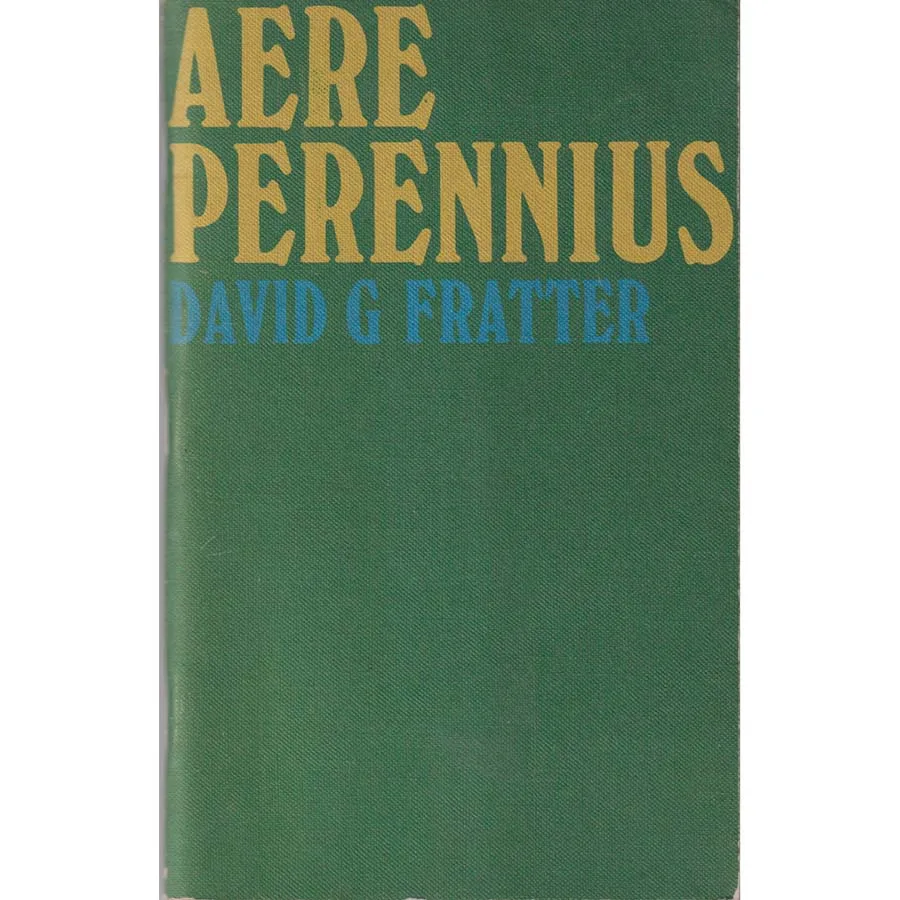
Publisher: MaCmillan
Format: Paperback
ISBN: none
Aere Perennius, compiled by David G. Frater and published by Macmillan in 1968, is a collection of Latin literature produced for students in the days when schools apparently assumed that a perfectly reasonable educational activity was to hand somebody a page of Latin and wait for civilisation to emerge.
The title comes from Horace’s famous phrase “aere perennius” — roughly, “more lasting than bronze” — his confident prediction that poetry would provide a monument more durable than anything constructed from metal. More than two thousand years later people are still quoting him, so on this occasion the poet’s marketing department appears to have been substantially correct.
Frater’s volume belongs to the tradition of school and college classical readers intended to introduce students to worthwhile passages of Latin rather than merely drilling them through endless sentences about farmers carrying spears towards Gaul.
Published by Macmillan in 1968, it runs to around 119 pages and was reviewed at the time alongside other school classics texts, firmly placing it in that vanished educational world in which Latin remained a normal enough school subject for publishers to produce compact anthologies for pupils.
There is something rather appealing about the whole enterprise now.
Latin has the unusual distinction of being described as a “dead language” despite having stubbornly refused to disappear. It survives in law, medicine, science, inscriptions, mottos, churches, universities and the sort of school crests designed to ensure generations of pupils spend several years walking underneath words they cannot translate.
Books such as Aere Perennius were intended to bridge the gap between learning the machinery of Latin and discovering why anybody had bothered preserving the language in the first place.
Because conjugating verbs is all very well, but sooner or later somebody has to reveal that the Romans actually wrote things worth reading.
And write they did.
Roman literature gives us politicians boasting, poets complaining, philosophers contemplating death, historians documenting disastrous decisions and people making observations about love, money, ambition and human stupidity which remain annoyingly recognisable two millennia later.
The costumes change.
The bureaucracy survives.
That is one of the pleasures of classical literature. Ancient Rome can seem impossibly remote until somebody in a Latin text begins complaining about somebody else’s behaviour, at which point the intervening centuries suddenly become rather less impressive.
The very existence of this 1968 book is now interesting in another way. It comes from an era when classical education still occupied a much larger place in British schools and universities. A Latin anthology could be published by a major house such as Macmillan with the reasonable expectation that enough pupils, teachers and libraries would require one to make the exercise worthwhile.
Today, finding a copy feels slightly more archaeological.
Not quite excavating Pompeii, admittedly, but considerably less dusty.
For former Latin pupils, classicists, teachers, collectors of old school books and anyone who gets an unreasonable amount of pleasure from recognising amo, amas, amat, this is an attractive little survival from the world of traditional classics teaching.
It may also make an excellent gift for somebody who claims their school Latin has completely disappeared. Simply open the book in front of them and observe the strange process by which fragments buried since 1974 begin returning against their will.
Condition: Good. A sound used copy with the normal signs of age and handling expected from a book published in 1968. It has lasted rather longer than many educational fashions and, in keeping with its title, is making a respectable attempt at being more permanent than bronze.
No ISBN stated.
A pleasing vintage Latin reader with an excellent classical title, ideal for students, collectors and anyone nostalgic for the educational philosophy that difficult things were not necessarily improved by removing them.
Sold by Crappy Old Books — libri veteres, pretia parva, nonsense plentiful.
Or, for those whose Latin is rusty: old books, small prices, and quite enough showing off.
Keep browsing: See more Ancient Classics books Other books by David G Fratter
